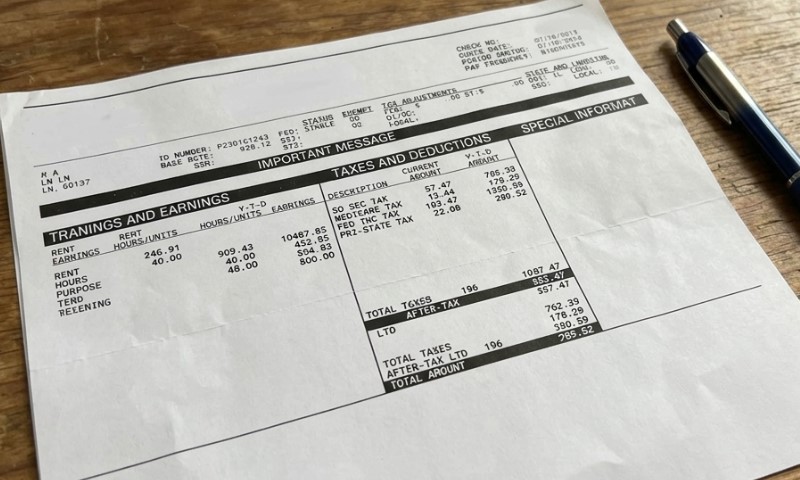
Look at a modern paycheck and federal income-tax withholding barely seems remarkable. Money is deducted before wages reach the employee, sent to the Treasury, and later credited against the worker’s annual income-tax liability.
Much of that familiar machinery can be traced to the Current Tax Payment Act of 1943. Congress was not creating the federal income tax.
Federal income taxation had existed for decades. What changed was the timing and method of collection.
Put simply, the 1943 Tax Change tied income-tax collection much more closely to payday. Wartime necessity accelerated the reform, but administrative efficiency made it durable.
Before 1943, Government Was Collecting Last Year’s Tax
Before the 1943 Tax Change, a considerable timing gap existed between earning taxable income and paying tax on it. Income earned during one year generally produced an obligation payable during the following year.
Describing the old arrangement as everyone writing one enormous annual check would be too neat.
Experience with tax policy tends to make one cautious about explanations that tidy away administrative details.
More important was the economic lag. Government waited for revenue while taxpayers had to retain enough money to satisfy obligations tied to income they had already earned.
Revenue Act changes in 1942 made that problem much larger. Millions of Americans entered the federal income-tax system as wartime policy greatly expanded the income-tax base.
Returns reporting net income numbered about 7.5 million in 1940, climbed to 33.6 million in 1942, and reached 40.6 million in 1943.
Collection now presented an administrative question as much as a revenue question. Millions of relatively inexperienced taxpayers had to reserve enough income to meet later federal obligations.
Any system depending heavily on households preserving future tax money carries an obvious risk that some of that money will be spent first.
Earlier federal withholding arrangements had existed, and Social Security taxes were already being collected through payroll.
Broad application of current withholding to individual federal income taxes was the lasting change introduced in 1943.
Why Wartime Washington Wanted Withholding
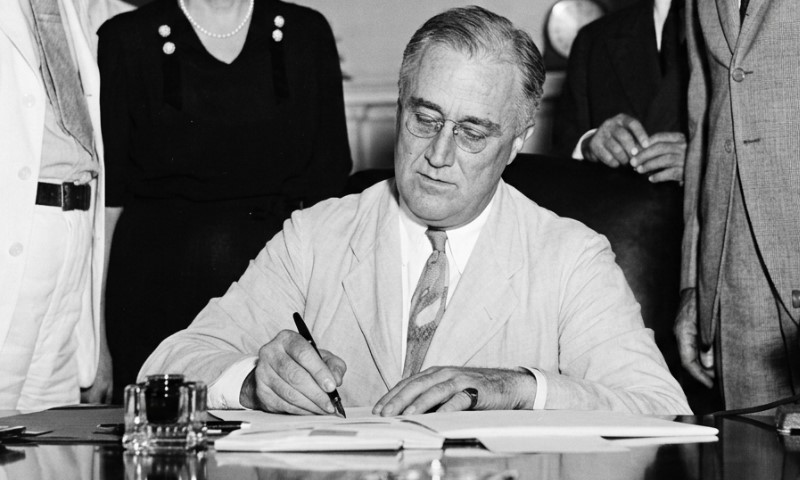
World War II required federal spending on a scale that made delayed revenue collection increasingly impractical.
Fiscal 1941 produced about $8.7 billion in federal receipts against $13.7 billion in outlays. By fiscal 1943, receipts were roughly $24.0 billion while outlays had risen to about $78.6 billion. Under those conditions, collection timing was no longer a minor administrative matter.
Receiving taxes many months after taxable income had been earned was poorly suited to a government financing a major war.
Withholding improved collection in several important ways:
- Treasury receipts arrived more regularly during the year.
- Tax money could be collected before households spent funds later needed for federal obligations.
- Millions of newer taxpayers stayed closer to current on their liabilities.
- Employers became collection intermediaries, reducing dependence on later collection against individual taxpayers.
None of those changes automatically altered a worker’s final tax liability.
They altered the government’s ability to collect it.
That distinction is easy to overlook because debates about taxation usually concentrate on rates, brackets, and deductions. Collection machinery receives less attention, although a government notices very quickly when that machinery performs badly.
Wartime revenue needs supplied the urgency. Administrative efficiency supplied the reason withholding continued after wartime financing pressures eased.
How Do You Switch Systems Without Charging Two Years at Once?
View this post on Instagram
Moving to current collection created an awkward problem in 1943. Taxpayers still had obligations tied to 1942 income. Immediate collection against 1943 income could therefore leave households financing prior-year and current-year liabilities at roughly the same time.
Beardsley Ruml, treasurer of Macy’s and chairman of the Federal Reserve Bank of New York, proposed a direct answer. His “Pay-As-You-Go plan” called for moving taxpayers onto current payment while canceling the previous year’s liability.
Objections centered on distribution as much as administration.
Complete cancellation made the transition easier to operate, but taxpayers carrying the largest prior-year liabilities could also receive the largest dollar benefits.
Congress therefore faced a familiar public-finance trade-off. Administrative simplicity pointed one way, while concerns about how the benefit of forgiveness would be distributed pointed another.
Congress eventually adopted a compromise. Seventy-five percent of the lower of a taxpayer’s 1942 or 1943 tax liability was forgiven.
Current withholding also began taking 20% of wages above applicable withholding exemptions for many workers. Two separate problems were therefore being addressed at once.
Prior-year liabilities had to be handled without imposing an excessive transition burden, while a workable system had to be created for collecting tax on current earnings.
Administrative reforms often look simple once the transition costs have been forgotten.
In 1943, those costs were very much part of the legislation.
What Survived After the Wartime Emergency

Wartime transition provisions eventually disappeared, but current collection continued.
Employers today still calculate federal income-tax withholding, deduct money through payroll, and remit those amounts to the government. Rates, brackets, forms, exemptions, credits, and withholding calculations have changed repeatedly since 1943.
A tax system can change considerably without changing its central collection principle.
Under current withholding, workers generally prepay federal income tax while earning wages rather than waiting until an annual return is filed.
Calling withholding a separate tax would therefore be incorrect. Amounts deducted through payroll are generally credits toward a taxpayer’s eventual federal income-tax liability.
Annual filing reconciles those advance payments against what the taxpayer actually owes. Someone with too little withheld may have a balance due. Someone with excess withholding may receive money back.
Such distinctions matter because a paycheck deduction and a final tax obligation are related, but they are not necessarily identical.
Withholding is a collection method first. Treating it as the tax itself confuses administration with liability.
A Collection System That Became Infrastructure
More than eight decades later, the significance of the 1943 Tax Change lies less in any particular wartime rate than in its collection architecture—an administrative system that endured for decades, its legacy still visible today in the IRS’s aging processing systems.
Federal revenue could arrive throughout the year. Wage earners could stay comparatively current on their tax obligations. Annual filing could operate largely as reconciliation rather than collection of an entire year’s liability after much of the income had already been spent.