
Few financial products feel as ordinary in American life as a 30-year fixed-rate mortgage. Someone buys a house, borrows the money, and agrees to make payments for three decades.
American housing finance is actually an international outlier in that respect. Long mortgages with interest rates fixed for their entire duration are much less common in many other countries.
We all know about the 30-year mortgage. I just never stopped to wonder why 30 became the number. To my surprise, nothing about thirty years was inevitable.
Banks did not gather one day and calculate that exactly three decades represented the perfect duration for a home loan.
Modern mortgage terms developed gradually after an older lending system collapsed during the Great Depression. As with quite a few financial conventions, today’s familiar arrangement started as an answer to a very specific problem.
How a 30-Year Mortgage Became an American Standard

Long mortgages could not become common simply because borrowers preferred smaller monthly payments.
Lenders faced another problem. A bank issuing a fixed-rate mortgage for decades commits capital while taking considerable interest-rate risk.
If market rates climb sharply, the lender is still collecting the older fixed rate agreed upon years earlier. Making such loans common required a financial system capable of supporting them for decades.
Fannie Mae Helped Make Long-Term Lending Practical
That changed the economics of mortgage lending. Selling mortgages gave lenders additional liquidity. Capital tied up in one home loan could return to the lending system and finance another purchase.
Asking a bank to issue a 30-year loan is much easier when that bank does not necessarily have to hold the loan for all 30 years.
Secondary markets also helped turn mortgages into a more standardized financial product.
As government-backed lending expanded and loans became easier to buy and sell, lenders had stronger reasons to use similar terms, underwriting rules, and repayment structures.
Fixed Rates Gave Borrowers an Unusual Advantage
Borrowers gained something valuable as long-term fixed-rate lending spread. When interest rates rise, a homeowner can continue paying the older fixed rate.
When rates fall enough to justify the expense, that homeowner may refinance into a cheaper loan. Borrowers receive protection against rising rates while still having an opportunity to benefit when rates fall.
Lenders carry much of the opposite risk, which is another reason institutions such as Fannie Mae and a functioning secondary market became so important.
Housing patterns changed dramatically during the same broad period. American homeownership rose 43.6% in 1940 to 61.9% in 1960.
Mortgage reform should not receive all the credit for that increase. Postwar prosperity, population growth, suburban construction, federal housing policies, veterans’ programs, and other economic forces also shaped the boom.
Still, increasingly standardized long-term financing made buying a home possible for households that might have struggled under earlier loan structures.
By the postwar decades, government-backed lending and private mortgage markets were increasingly centered on a familiar model:
- Long duration
- Fixed interest
- Scheduled amortization
- Predictable monthly payments
Why Thirty Years Eventually Made Financial Sense

Stretching the principal across more monthly payments reduces each payment. A family that struggles to carry a mortgage over 10 or 15 years may find the same principal manageable over 30.
One thing that became clearer to me while reading about mortgage history was that 30 years was not really about the number itself.
Instead, it was about what that number did to the monthly payment. Consider a $300,000 mortgage carrying a 7% interest rate.
Spread across 30 years, principal and interest come to roughly $1,996 per month. Shortening that repayment period would raise the monthly obligation substantially.
Lower payments do not mean the house becomes cheaper. Borrowers pay interest for a longer period, which increases the total interest cost across the life of the loan.
Equity also accumulates slowly during the early years. A $150,000 mortgage carrying a 4.5% rate, for example, can produce a monthly payment close to $760.
Around $560 of an early monthly payment may go toward interest rather than principal. Only about $200 would reduce the actual loan balance in that example.
Thirty years therefore offered a practical compromise. Households gained lower monthly obligations while accepting a longer repayment schedule and greater lifetime interest costs.
Before the Depression, Buying a House Was Much Riskier
Around 57% of Americans rented rather than owned their homes during the period preceding major federal mortgage reforms.
Buyers who did obtain mortgages often received loans lasting only about five years. Five years sounds remarkably short compared with modern financing because borrowers were rarely expected to pay the entire house off during that period. Many loans operated as balloon mortgages.
A homeowner made regular payments for several years, but a substantial balance was still due when the loan matured.
Paying that final balance in cash was unrealistic for many households, so borrowers commonly obtained another mortgage and carried the debt forward.
Homeownership therefore depended on something homeowners could not fully control, continued access to refinancing.
A household could make every scheduled payment and still face serious trouble once the loan matured. Another bank, or perhaps the same bank, needed to agree to issue a replacement loan.
During good economic conditions, that arrangement could keep functioning. Banks lent, borrowers refinanced, and short mortgages rolled into new ones.
Once credit disappeared, however, its weakness became impossible to ignore.
How the Depression Broke the Old Mortgage System
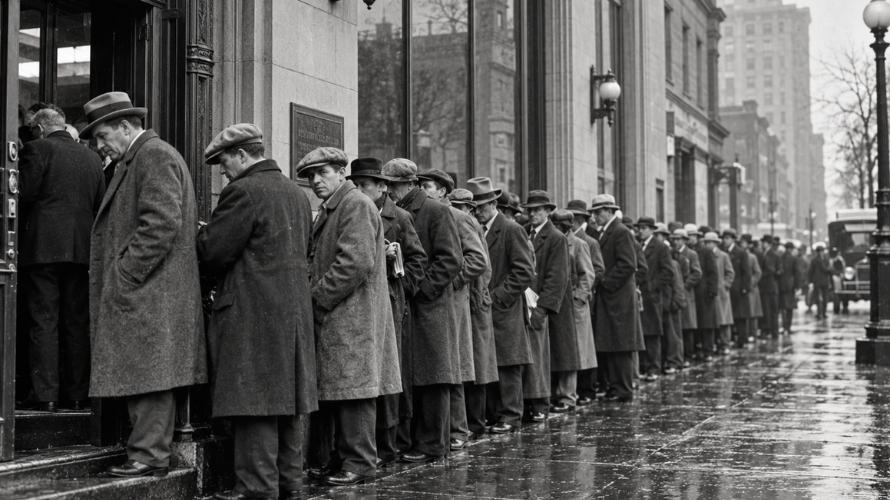
Economic collapse during the early 1930s put enormous pressure on banks, businesses, workers, and homeowners.
Banks became less able and less willing to issue fresh loans. Borrowers approaching the end of short-term mortgages suddenly discovered that refinancing could no longer be taken for granted.
A mortgage-finance crisis was clearly underway by 1932, accompanied by widespread foreclosures.
Consider the position of a homeowner who had paid reliably for several years. A five-year mortgage reached maturity, a large balance became due, and refinancing was no longer available.
Failure could occur even without years of missed monthly payments.
One chain of events mattered enormously:
- Short-term mortgages left large balances unpaid.
- Large balances made refinancing necessary.
- Banking failures reduced access to fresh credit.
- Homeowners could no longer refinance those balances.
- Foreclosures followed.
For years, I had assumed Depression-era mortgage failures mainly involved homeowners simply becoming unable to make their regular payments. Short balloon loans added another source of danger. Losing access to credit itself could put a household in trouble.
Washington Started Redesigning Home Finance
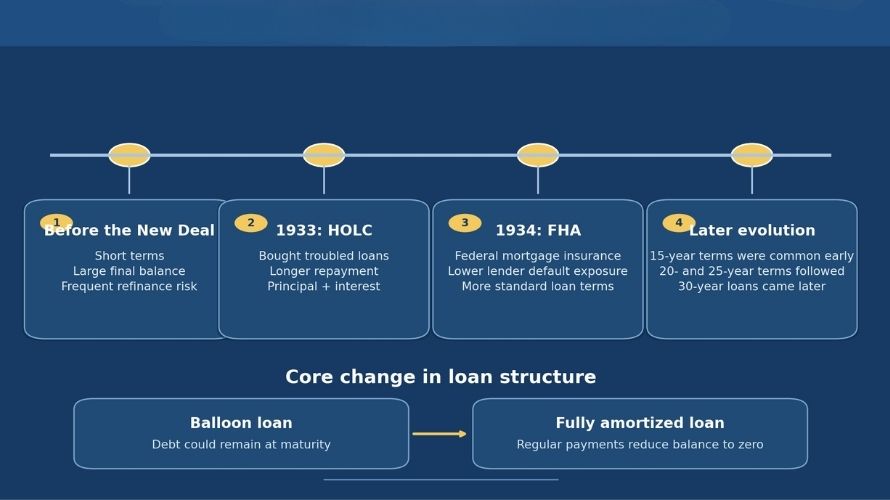
New Deal housing programs began changing how Americans borrowed for homes. Roosevelt’s administration created the Home Owners’ Loan Corporation, commonly called HOLC, to deal with distressed mortgages.
HOLC purchased troubled loans and refinanced them into longer arrangements that included regular payments toward both principal and interest.
Borrowers no longer faced quite the same dependence on a giant unpaid balance at maturity.
Another major change arrived in 1934 with the creation of the Federal Housing Administration. FHA mortgage insurance reduced lender exposure to borrower default while federal standards encouraged more predictable loan structures.
Early FHA mortgages were not 30-year loans. Terms around 15 years were initially common, followed later by 20-year and 25-year financing.
More important than the exact number of years was the growing use of fully amortizing mortgages. Amortization sounds technical, but its basic logic is simple.
Keep making payments for the full term, and eventually the mortgage balance reaches zero. Older balloon financing worked differently.
Regular payments did not necessarily eliminate the debt by maturity, leaving borrowers with a large final obligation.
One detail kept catching my attention while reading about this period. Mortgage reform was less about choosing 30 years at first and more about removing the recurring refinancing gamble built into older loans.
FHA Did Not Simply Invent a 30-Year Loan in the 1930s
Actual events were slower. Congress did not authorize FHA insurance for 30-year mortgages on newly constructed homes until 1948. Similar 30-year financing for existing homes became available in 1954.
Even during the years after World War II, shorter terms were still common. Between 1946 and 1954, an average FHA mortgage lasted about 21 years.
Widespread acceptance of the 30-year mortgage came later, roughly around the 1960s.
Great Depression reforms established many of the institutions and lending principles that eventually made long fixed-rate mortgages practical.
Policymakers expanded mortgage duration gradually as experience with amortizing loans, federal insurance, and housing finance accumulated.
No single law suddenly transformed American mortgages into the form familiar today. I used to think the explanation was much simpler.
Digging into the dates makes the gradual nature of the change hard to miss.
Crisis created the need for reform. Several decades of policy and financial development produced the mature 30-year mortgage.
That Generation Took One for the Team
Homeowners during the Great Depression learned the weaknesses of the old mortgage system the hard way.
Short loans came due, refinancing disappeared, banks failed, and families who had made years of payments could still lose their homes because they could not cover a large final balance.
In a sense, that generation took one for the team. Their losses exposed a system that depended too heavily on refinancing.
Reforms that followed gradually introduced longer terms, amortization, mortgage insurance, and a stronger secondary market.
Modern homeowners inherited the result: loans that can be paid off on a clear schedule without having to return to a bank every few years just to keep the house.