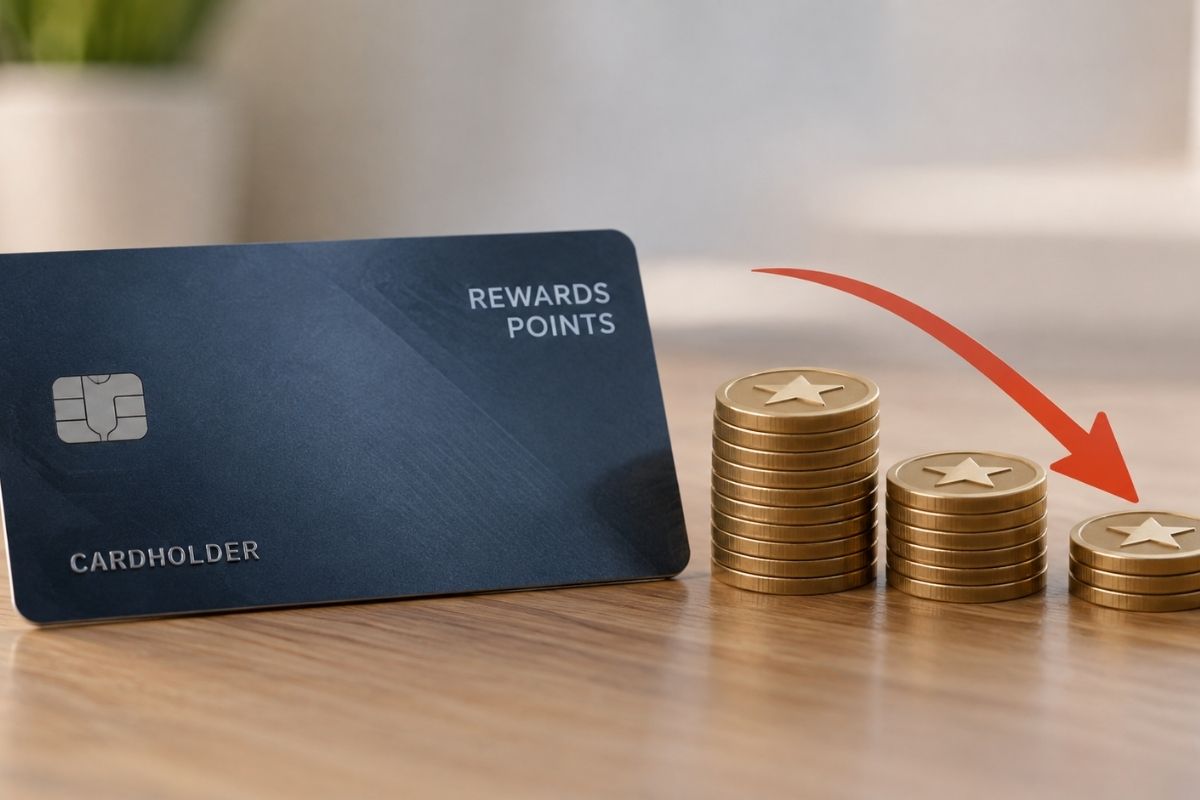
A $400 flight costs 40,000 points. At that price, each point buys one cent of travel.
Months later, that same $400 seat costs 50,000 points. Your account still shows exactly as many points as before, yet each one now buys only 0.8 cents of travel. Purchasing power has fallen 20%.
Rewards cards now account for 92% of U.S. credit-card transactions, so this is hardly a problem limited to people who spend their evenings comparing airline award charts.
Points and miles have become part of ordinary household spending, often used to justify annual fees or influence which card gets pulled out at checkout.
A better way to think about rewards is as a private currency with an exchange rate controlled largely by the program operator. Your balance may look stable while that exchange rate gets worse.
How Credit-Card Points Get Devalued
Devaluation can be very simple. A hotel night that once cost 30,000 points might later cost 40,000. An airline ticket priced at 25,000 miles might jump to 35,000. Same reward, higher point price.
Other changes are less obvious.
Capital One, for example, changed its Emirates Skywards transfer ratio in January 2026. A 1:1 transfer became 1:0.75.
Someone moving 100,000 Capital One miles would receive 75,000 Emirates miles instead of 100,000, a 25% reduction in the airline currency received.
Chase went a step further with Emirates in October 2025 by removing the airline as an Ultimate Rewards transfer partner altogether. A balance did not have to shrink for an option to disappear.
Redemption rules can shift inside a card program too. Chase introduced Points Boost in 2025, replacing broadly fixed 1.25x or 1.5x travel redemption boosts on several Sapphire and Ink cards with a more dynamic model.
Some bookings can still offer strong value, but cardholders have less certainty that a point will buy the same amount of travel across every eligible booking.
I had known for years that loyalty programs changed their charts. What I had not really stopped to consider was how neatly a company could preserve the number on your screen while changing its economic meaning.
Points You Already Earned Can Be Affected
Future rewards are easy to think about. A card issuer announces that spending next month will earn fewer points, and customers can decide if they still want to use the card.
Already-earned rewards feel different.
People often choose a card after looking at its sign-up bonus, transfer partners, redemption rate, travel portal, or other advertised benefits. Spending then happens under those expectations. Later rule changes can apply across the entire balance, including points earned under the earlier setup.
Complaints tied to credit-card rewards have risen sharply.
Reported complaints climbed 70% compared with pre-pandemic levels, with devaluation among the major concerns identified by federal consumer regulators.
Issuers also forfeit, expire, revoke, or otherwise remove hundreds of millions of dollars in earned rewards value each year. Devaluation sits beside those losses as another way the economic value of a rewards balance can change after the customer has done the spending required to earn it.
A bank balance works differently. Put $1,000 in an account and, ignoring fees or interest, the number still represents $1,000.
Hold 100,000 points and there is no comparable promise about purchasing power. Value depends on the redemption rules in force when you finally use them.
Why Issuers Devalue Rewards

Unused points can sit on a company’s books as liabilities because customers may later redeem them. Travel redemptions have real costs.
Partner deals with airlines, hotels, and other companies also get renegotiated, sometimes changing the economics behind a transfer program. Consumers earned just over $26 billion in credit-card rewards in 2019. By 2024, that figure had climbed nearly 80% to more than $47 billion.
A program that large creates a substantial cost center as well as a marketing tool.
Higher redemption prices can reduce that cost without forcing an issuer to scrap the rewards program. Lower transfer ratios can accomplish something similar.
Dynamic pricing can give a company more control over how much value leaves the system on each redemption.
None of that means every devaluation is improper. Costs change, partner contracts change, and a program designed five years ago may no longer work at the same economics.
Still, an explanation based on cost does not erase the effect on the customer. A person who saved points for two years can discover that the same trip now requires 20% or 30% more of them.
Accounting logic and household frustration can both be valid at once.
Can Issuers Legally Do It?
Card agreements and rewards-program terms commonly give issuers broad power to modify benefits. Rewards changes also do not generally receive the same federal advance-notice treatment attached to major changes such as higher interest rates or new fees.
That helps explain why a devaluation can appear with little warning.
Contract language, however, does not give companies unlimited freedom. Federal consumer regulators have warned that cutting the value of rewards already earned can raise unfair or deceptive practice concerns, especially when customers were encouraged to open or use a card based on specific claims about those rewards.
In late 2024, the Consumer Financial Protection Bureau warned that some practices could resemble a bait-and-switch.
Vague language or buried restrictions may not be enough if prominent marketing created a materially different expectation.
One state offers a useful contrast. New York requires 45 days’ notice for certain rewards-program changes and gives affected cardholders 90 days after notice to redeem earned rewards.
Such rules do not mean every point devaluation is illegal. Much depends on how a program was marketed, what its terms allow, how the change is carried out, and how already-earned rewards are treated.
Legal questions become especially important when a company sells one value proposition at sign-up, benefits financially as customers spend, then materially weakens that proposition after the points are already in customer accounts.
How to Protect Yourself
Best protection starts with treating points as purchasing power rather than a score.
A large balance can look impressive, but the number alone says very little. Check what a realistic redemption would buy now and calculate the value per point:
A $500 ticket costing 50,000 points gives you 1 cent per point. If that ticket later costs 62,500 points, value falls to 0.8 cents per point.
Holding points indefinitely creates two separate problems. Inflation can make the reward itself more expensive over time, while the loyalty program can also change its own pricing rules.
Cash kept in an interest-bearing account has at least some chance to offset inflation. An unused point balance does not work that way.
Having a rough use in mind can help. You do not need to redeem every point immediately, but accumulating hundreds of thousands without any plan leaves more value exposed to future program changes.
Periodic checks do not need to turn into a second job. Pay attention when familiar award prices rise, transfer ratios get worse, an airline or hotel partner disappears, or a fixed redemption rate is replaced by dynamic pricing.
Credit card rewards can lose value over time, and high interest charges can quickly outweigh any benefits earned
Cash back is also worth considering if constant point math sounds like unpaid part-time work.
Want to learn more about how credit card cashback works? Watch the video below for a quick explanation.
Points Are Valuable, but Their Value Is Not Fixed
Americans earned more than $47 billion in credit-card rewards in 2024. Plenty of that value is real. Used carefully, points can reduce travel costs, offset purchases, and make a good card noticeably better.
No balance, though, locks in what those rewards will buy later.
An issuer does not have to remove 20,000 points to make a 100,000-point account less useful. Raising a redemption price can produce the same economic result while leaving every point visible.
Rewards can still be worthwhile. Mistake lies in treating a large balance like money whose purchasing power has already been secured.
A useful habit is simple: stop looking at the balance as the value. Value is what those points can actually buy today.