Calling IRS technology a product of the 1960s is slightly imprecise, though the description is not far off.
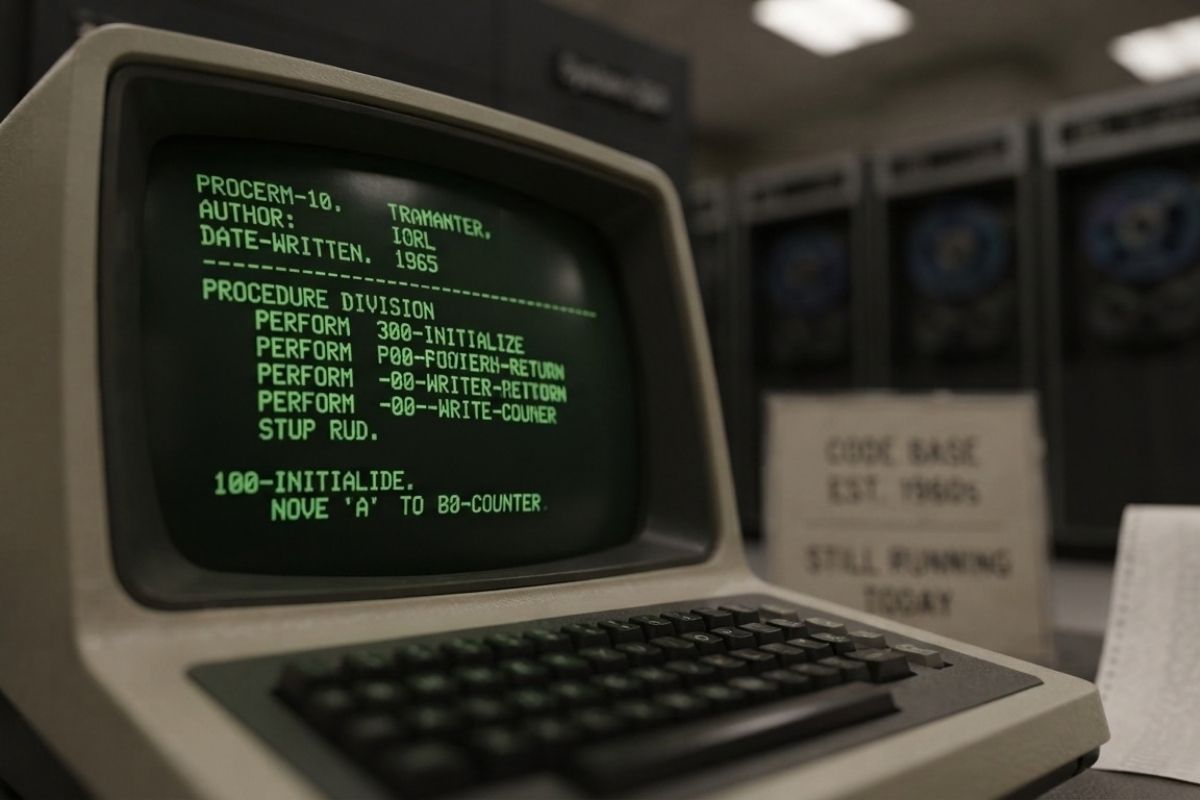
Centralized computer processing at the agency began in the early 1960s with an IBM 7074. Hardware has changed many times since then, but important parts of the software architecture developed during that period survived.
A central example is the Individual Master File, or IMF. Established in 1970, it maintains individual taxpayer accounts and plays a major role in processing returns, recording balances, and issuing refunds.
Much of that work still depends on Assembly Language Code, usually called ALC, alongside COBOL.
Modern equipment replaced the original machines long ago, while older software and processing logic continued across successive generations of hardware.
Replacing such a system is difficult because it performs an indispensable administrative function and contains decades of tax-processing rules.
In tax administration, age is inconvenient, and so is failure, considerably more so.
Why the Old System Is Still Used
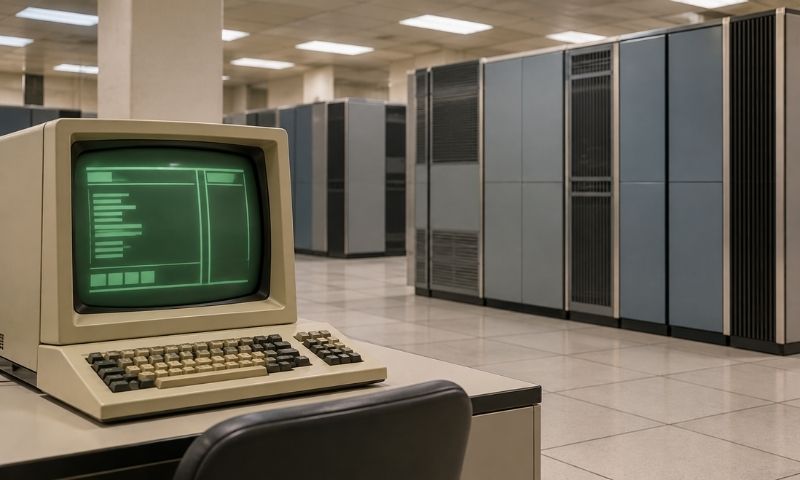
COBOL systems have processed enormous quantities of financial and administrative data for decades.
When a system performs correctly under heavy workloads, replacing it becomes a question of cost and operational risk rather than simple technological preference.
Private companies often face a similar calculation.
Front-end applications may be replaced several times while an older COBOL back end continues operating because replacement costs are high and the potential consequences of failure are difficult to justify.
Knowing COBOL is only part of the problem. Far harder is learning how a multimillion-line system has been modified, patched, interpreted, and connected to other programs over several decades.
Institutional knowledge therefore matters almost as much as programming skill.
Federal tax law adds another complication, with credits, deductions, filing statuses, thresholds, exceptions, and administrative procedures all have to be translated into processing rules.
The standardization of paycheck withholding added another layer to tax administration, requiring systems to account for taxes collected directly from employees’ wages throughout the year.
Several categories of information may eventually become embedded in the system:
| Tax-processing area | How It Affects Processing |
| Eligibility requirements for credits and deductions | Rules determining which taxpayers qualify for specific tax benefits |
| Phaseout rules tied to income thresholds | Calculations that reduce or eliminate benefits as income rises |
| Filing-status calculations | Rules for applying the correct treatment to single, married, head-of-household, and other filing categories |
| Special treatment for particular forms of income | Different calculations for wages, investment income, self-employment income, and other categories |
| Exceptions created by later amendments | Additional rules introduced when Congress modifies existing tax provisions |
| Administrative procedures affecting balances and refunds | Processing rules that determine account balances, payments, adjustments, and refund amounts |
Replacing the software therefore means recreating those rules correctly, not merely rewriting code in a newer language.
Why IRS Modernization Is So Difficult
IRS officials have been trying to replace major parts of the old architecture for more than two decades. Work on the Customer Account Data Engine, known as CADE, began around 2000.
Plans called for it to replace the Individual Master File. When that effort failed to accomplish the objective, the agency moved to a revised program known as CADE 2. Progress slowed for several reasons.
Budget reductions limited modernization capacity at various points. Newly enacted tax provisions also forced programmers to keep modifying systems already in operation.
Congress can change tax law much faster than an agency can replace the systems administering it. IRS engineers therefore have to perform two demanding tasks at once.
Existing systems must continue processing returns, payments, balances, and refunds, while replacement systems are built and tested.
Filing seasons do not stop while modernization takes place. Staffing creates another constraint. Programmers familiar with ALC and COBOL have become harder to recruit.
Language knowledge alone, however, does not solve the problem. Experienced employees may know why a particular routine exists, what earlier change created it, and which other systems depend on it.
Losing that institutional knowledge during modernization can introduce errors that are difficult to detect before large volumes of taxpayer data have already passed through a new system.
Problems Caused by Aging IRS Technology

Continued operation does not mean continued use is cheap or efficient. Older IRS systems make several important tasks more difficult. Real-time account access becomes harder when information passes through multiple older systems. Tax-law changes can require substantial modification of software carrying decades of prior rules.
Newer applications also have to communicate with databases designed under very different technical assumptions. Training new programmers in COBOL addresses only part of the problem.
Much of the relevant expertise concerns the specific architecture, conventions, dependencies, and modifications accumulated inside IRS systems over several decades.
Operational failures show why those complications matter.
In April 2018, IRS technology problems disrupted taxpayer-facing services on Tax Day, when filing demand was at its highest. Officials extended the filing deadline by one day.
Older systems may be stable, but stability at the component level does not eliminate risk across highly interconnected infrastructure. A failure in one area can still disrupt several related services.
COBOL’s age does not make it inherently secure. Effective protection depends on architecture, access controls, monitoring, maintenance, and careful engineering.
IRS records contain exceptionally sensitive financial information. Security therefore cannot depend on the relative obscurity of an older programming language.
Current IRS Modernization Efforts
Modernization received substantial additional funding under the Inflation Reduction Act of 2022.
Nearly $5 billion was allocated for IRS business-systems modernization.
Under the IRS Strategic Operating Plan issued in 2023, officials set two important retirement targets at that time
- Business Master File retirement in 2027
- Individual Master File retirement in 2028
Those dates are targets rather than guarantees. Anyone familiar with large government technology programs learns to treat scheduled completion dates with some caution.
Modernization also does not require every older system to disappear before newer capabilities can be introduced.
Advanced analytics, machine learning, improved data processing, and newer taxpayer services can operate alongside older account systems while replacement work continues.
Large private institutions often follow the same pattern because replacing every component at once creates unnecessary operational risk. An incremental transition may be less dramatic than wholesale replacement, but it is administratively easier to defend.
Why Replacing Old Code Takes So Long

IRS technology is sometimes described simply as evidence of government bureaucracy. Such an explanation is incomplete.
Individual Master File operations sit near the center of federal tax administration and contain decades of accumulated processing logic.
Keeping older systems creates measurable costs. Technical expertise becomes harder to find. Tax-law changes become more difficult to implement.
Real-time services are harder to build. Security work becomes more complicated. Replacing them creates a different set of risks.
Experience with tax administration tends to make one cautious about simple explanations. IRS officials have not kept old technology because newer alternatives do not exist.
In tax administration, the more important question is whether its functions can be transferred without disrupting revenue collection, taxpayer accounts, or refunds.
Modernization therefore depends on replacing outdated technology without damaging the administrative functions built around it.